


Ciao,
Last October, I published the AI Collaboration Canvas, a first attempt to build a tool to help people define a strategy for collaborating with artificial intelligence.
Over the past months, I’ve brought my method into training sessions and workshops across very different organizational settings. This allowed me to refine my approach for helping companies move from occasional AI experimentation to systematic, measurable, and responsible adoption. The canvas has thus become the starting point for something larger, which I’m now bringing into focus under the name AI Collaboration Blueprint.
Nicola ❤️
Artificial intelligence as an organizational change project
Introducing artificial intelligence into a company is, first and foremost, a change management problem, which requires working in parallel on two fronts.
The first is the adoption strategy: which processes are candidates, with what level of AI integration, in what temporal order, and against what evaluation criteria. This strategy cannot be drafted at a desk. It has to be built starting from real processes, from the people who execute them, from the actual constraints of the technology stack and the regulatory framework.
The second is skill development: not so much technical skills in the strict sense, but people’s ability to work with AI within their own processes. Not everyone needs to know how to build complex prompts or automations. But those who use AI must be able to recognize when output is reliable, when it needs to be verified, when it should be rejected, and they must integrate this judgment into their workflow.
A strategy without skills produces projects that never take off. Skills without strategy produce isolated experiments that never consolidate. Both are needed, and they must be built together.
The AI Collaboration Blueprint
The AI Collaboration Blueprint is the method I developed to move an organization from the situation of “a few people are experimenting, nobody knows whether it’s working” to the situation of “we have an adoption strategy, people have the skills to execute it, we know how to measure results and manage compliance.”
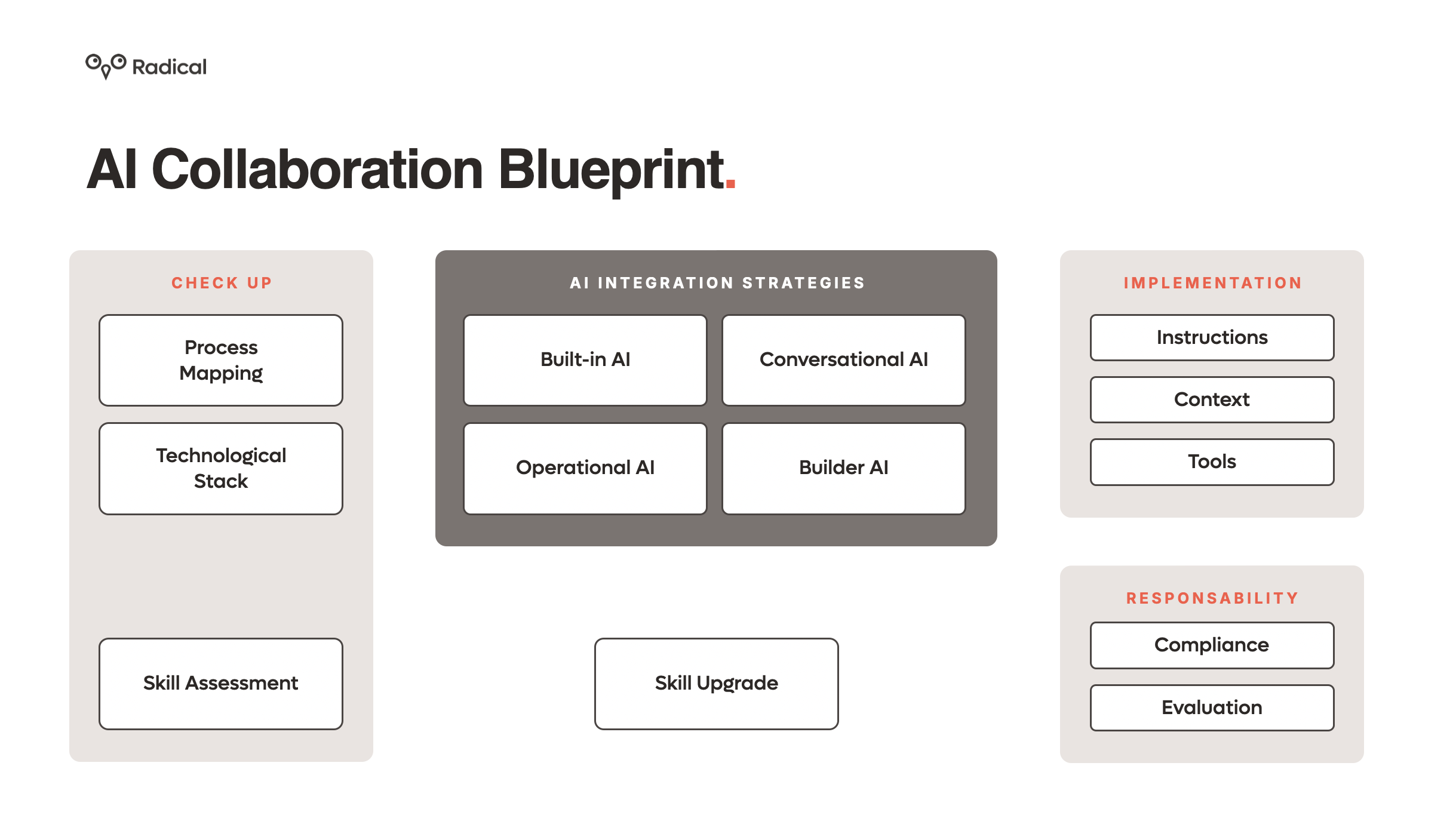
The path is structured in phases, each of which produces tools the organization can use. It starts with the check-up, which begins with process mapping carried out in two stages. In the first, an AI agent interviews people and returns structured descriptions of their individual workflows (including workarounds, exceptions, and the tacit knowledge that often doesn’t appear in operating manuals). In the second, we move to consolidation, comparing the individual variants of the same process and surfacing gray areas, duplications, and critical junctions. This is often the phase when pre-AI inefficiencies also emerge, ones that are better addressed before introducing new technologies.
In parallel, we proceed with:
Mapping the technology stack available within the company, to understand what is realistically activatable within the perimeter of the tools already in use and the policies in force;
An assessment of the skills the team has already developed in using artificial intelligence (how they use it, what they know about it, what they think they can do with it).
We then define an AI integration strategy for each process step, choosing among four modes:
Built-in AI. The artificial intelligence features already embedded in the productivity tools the company uses every day: Copilot inside Office, Gemini inside Google Workspace, and the AI functions of CRMs and business management systems. It’s the most accessible mode because it requires no investment and no new skills: the license is often already active, and the end user only needs to learn to recognize when it’s worth invoking. It’s also the most limited, because the AI does what the vendor has decided to let it do. Still, it’s the natural starting point for most people in a company.
Collaborative AI. The structured use of a conversational assistant like ChatGPT, Claude, Gemini, or a dedicated enterprise client based on the same models. The person works with the assistant iteratively to draft texts, analyze documents, prepare drafts, do targeted research, and structure complex reasoning. This strategy requires prompting skills, context management, and critical evaluation of output. It’s the mode that today has the greatest impact on individual productivity.
Operational AI. AI is embedded in automated workflows that execute repetitive tasks: an email arrives, an agent classifies it, routes it, and possibly prepares a draft reply. Here, the person intervenes only at verification checkpoints, not during execution. This strategy often requires engineers for flow design, integration with corporate tools, testing, and serious consideration of responsibility and error.
Builder AI. AI is used as an accelerator to build custom tools in very short timeframes that previously wouldn’t have been economically viable. Typically, these are deterministic utilities (automatic comparisons between two Excel sheets, account reconcilers, scripts that generate reports from scattered files) developed by business people with AI assistance, a practice now known as vibe coding. It doesn’t replace IT in managing complex systems, but it fills the gap between “I have an Excel sheet” and “I’d need a real information system”, a gap that, in mid-complexity organizations, is much wider than people think.
After determining the strategy, we move to implementation. A well-built pilot has four ingredients: a single business function, a single process (or subprocess), a small group of people willing to work actively on the change, and a defined time horizon of a few weeks. In this phase, we define the instructions to give the AI, the context it needs to produce output aligned with business objectives, and the tools it has access to. Often, we realize the information isn’t available because it’s locked in silos or stored in formats like PDFs that require an intermediate step of extraction and organization.
The path closes with responsibility. On the evaluation front, three metrics are essential: the AI’s error rate during the process; the actual impact on time, measured net of the cost of human verification; and the impact on the recipient's perceived quality of the final output. On the compliance front, we need periodic audits, documentation kept up to date, logs of significant uses, and a clear chain of responsibility: who approved AI use for this process, who verifies it continues to work, and who intervenes when something goes wrong.
The output of this phase feeds back into the strategy: what we learn from monitoring helps us review initial choices, expand where it works, and pull back where it doesn’t.
The value of the method
The AI Collaboration Blueprint starts from processes, not tools, so it works even with a constrained technology stack. It integrates compliance from the outset, which is indispensable in regulated sectors. It makes tacit knowledge explicit — the real bottleneck of any AI adoption program. And it distinguishes different levels of complexity, allowing organizations to start at the accessible level and raise the bar as skills mature and organizational choices consolidate.
The work produces communicable artifacts that also serve to report to decision-making levels — internal or group — on what’s being done and the results.
Radical Blueprint: the method becomes a product
There’s a problem with the work I’ve described so far: it doesn’t scale. A path like this, done traditionally, requires weeks of interviews, workshops, consolidation sessions, and debriefs. It’s a service that makes sense for companies that can afford dedicated consulting, and it cuts out exactly the segment that would need it most: organizations of twenty employees or more that understand they need to do something with AI but have neither the budget for traditional consulting nor the critical mass to build internal skills from scratch.
For the past few months, I’ve been working on Radical Blueprint, a platform prototype that turns the method into a self-service offering. The underlying idea is to build what, put plainly, is a consulting firm made of agents: AI agents serve as the team of consultants who administer questionnaires, conduct interviews, produce individual and collective reports, and translate data into operational recommendations. The human (for now, just me) stays where it’s actually needed: in methodological supervision and in direct engagement with those who lead the company or the team.
The path to get here has been deliberately long. First, a zero-technology MVP: live and online seminars, Claude skills, and working documents shared with clients. Months spent exploring the problem with traditional methods, understanding what people in companies really ask for, where the process gets stuck, which questions lead to useful answers, and which don’t. Only after consolidating that knowledge did I start turning it into a prototype built with Lovable.
The platform is multi-tenant: a dedicated workspace is created for a company or a team. The workspace owner can invite colleagues who begin the journey through questionnaires administered by an agent in a chat interface.
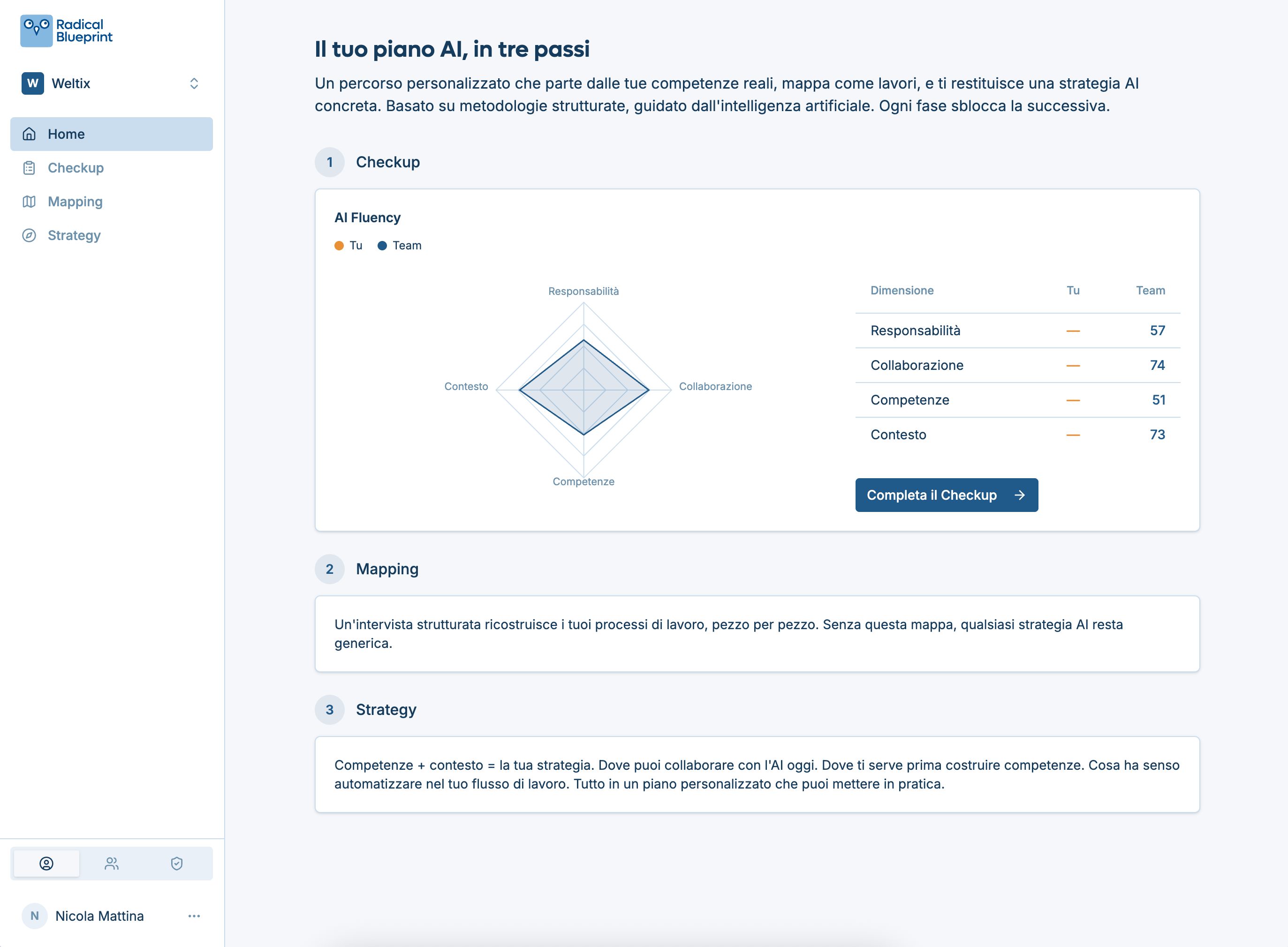
The questionnaires are analyzed in real time by another agent, which returns an individual report designed to help the user improve their ability to collaborate with AI.
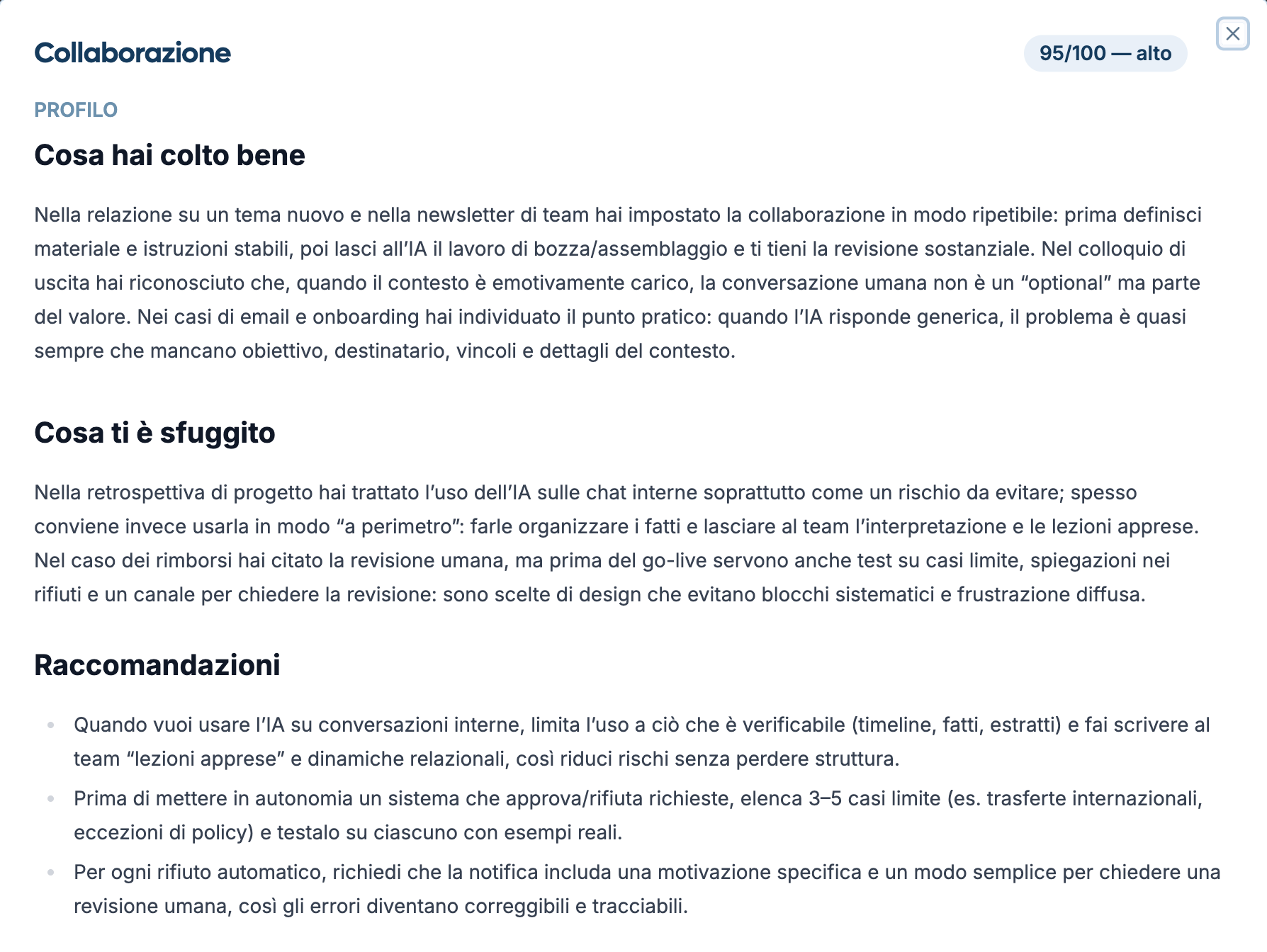
This kind of analysis would be impossible for a human, whereas an LLM can conduct it effectively at an extraordinarily low cost (a few euros) relative to the value it generates for the user.
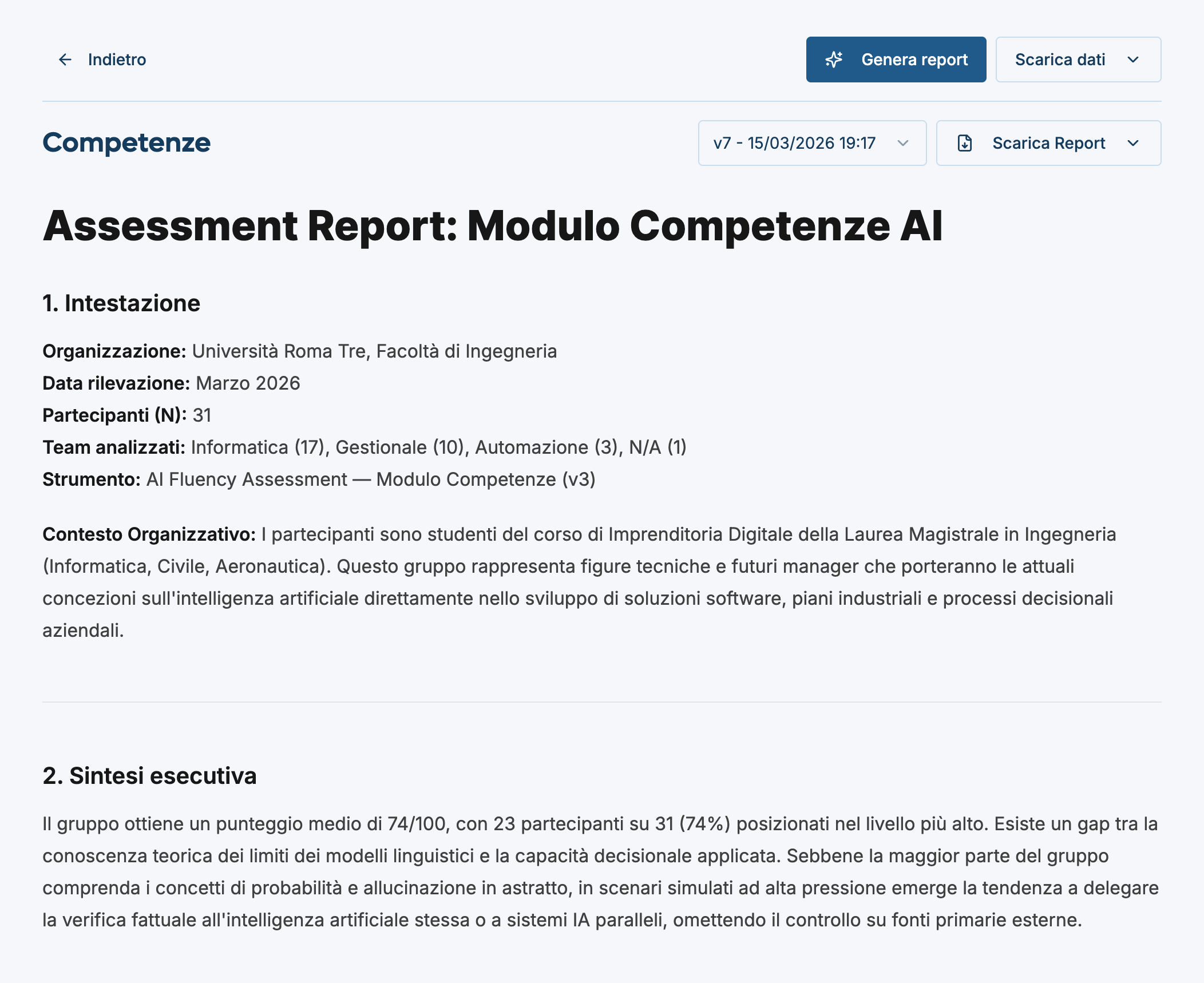
But it doesn’t stop there: the workspace owner can also generate a collective report for the entire team using an advanced reasoning model like Gemini Pro or Anthropic Opus 4.7. This work would take days of analyst time and would cost enough to make it entirely inaccessible to the vast majority of companies. Thanks to agents, an accurate and in-depth snapshot of AI adoption levels can be produced in a few days, self-service. With the right reference framework, a reasoning model can generate a highly detailed analysis. This, for example, is the beginning of the report I generated during a test with my students in the Digital Entrepreneurship course at Roma3 University.
The underlying logic is that every part of the method that can be executed by an agent must be executed by an agent, for two reasons. The first is access: making the service sustainable for companies that otherwise couldn’t use it. The second is consistent with the method itself: if I’m proposing to companies a model for building an AI adoption strategy within their processes, I have to start by applying it to my own processes. A consultant who preaches AI and only works with traditional tools (webinars, classroom lectures, e-learning) is a contradiction in terms.
Where I am now
Radical Blueprint is still an MVP, and I’m testing it successfully with pioneer clients: so far, I’ve transferred the check-up activity onto the platform, increasing the value of the assessment for clients. The support of AI agents in delivering and analyzing questionnaires goes well beyond what a basic Typeform form can do. The rest of the blueprint is still a set of prompts and skills for Claude, of varying complexity, that I use during my training sessions.
Just a few months ago, work like this would have required a team, much longer timelines, and a lot more money. Today, a product manager with a clear idea can independently build a prototype of a complex product, like a consulting firm without consultants. So far, it’s been a challenge that has taught me a great deal, from techniques for minimizing AI agent errors to techniques for managing a vibe coded project; meanwhile, together with an engineer friend, we’ve also developed a process for using Lovable as a prototyping environment inside a CI/CD pipeline typical of professional software development. But that will be the subject of another article.
The vision taking shape, piece by piece, is that of a consulting firm with no consultants, scaling like software-as-a-service. Six months ago, it couldn’t have been done. Today, it is possible.
La cultura come grammatica sociale lo sento molto. Nel B2B succede da anni: il cliente compra da chi parla la sua lingua intellettuale prima ancora di capire il prodotto. Il lusso ostentato è diventato imbarazzante, la conversazione profonda è il nuovo flex.
Il pattern è sempre lo stesso: gli articoli che pensiamo siano toroni sono quelli che sfondano. Satispay era un caso studio reale con numeri, con una tesi. Il pubblico non vuole contenuto generico, vuole analisi coraggiosa su cose che già usa. Nota mentale anche per me.